
Cloud Computing For Research
Cloud computing is an on-demand computing resource that is scalable and follows a pay-as-you-go model. Instead of a singular data center or super-computing center, large cloud providers have data centers spanning multiple locations. The largest cloud computing providers are Microsoft (Azure), Amazon (Amazon Web Services, AWS) and Google (Google Cloud Platform, GCP). Together, they are often referred to as “public” or “commercial” cloud providers.
For researchers, it is often helpful to be aware of these five key components related to cloud computing infrastructure:
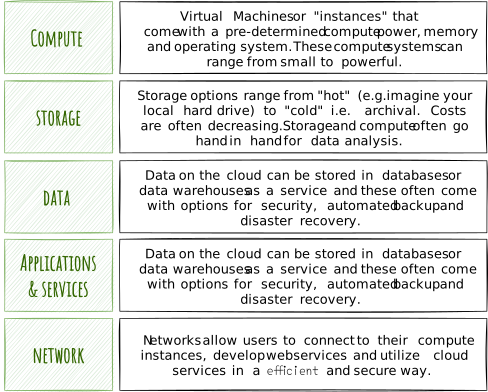
In contrast to buying your own desktop or laptop computer, a cluster of machines, or with buying external storage devices (such as a RAID, redundant array of independent disks), cloud computing allows you to provision computing and storage on machines that only available to you through an intermediated interface (such as a web-browser or through ssh).
As articulated by the Software Sustainability Institute (SSI), there are three main types of cloud computing platforms: Private cloud, community cloud and public cloud. Private clouds often take the form of institutional high-performance computing clusters. Examples of community cloud include National Science Foundation (NSF)-funded platforms such as XSEDE and the NASA Adapt Science Cloud. The public cloud is named so because any member of the public can utilize its services. The fundamental difference between the public cloud and community or private cloud is that the public cloud is developed by commercial companies and follows a pay-as-you-go model as opposed to a funding allocation model which you need to apply and be approved for. Commercial cloud providers are also frequently inventing, updating and improving their catalog of services to cater specifically to industry and enterprise customers; some researchers may find that the services offered on the commercial cloud can help accelerate their scientific workflows especially when dealing with large datasets.
Given the different types of cloud platforms, and the vast number of computing options available to researchers, in the next chapter, we will discuss how to assess if the public cloud is right for your research.